Review


anti integrin αvβ5 mouse mab  (R&D Systems)


Bioz Verified Symbol R&D Systems is a verified supplier
Bioz Manufacturer Symbol R&D Systems manufactures this product  
  • Logo
  • About
  • News
  • Press Release
  • Team
  • Advisors
  • Partners
  • Contact
  • Bioz Stars
  • Bioz vStars
  • 93

    Structured Review

    R&D Systems anti integrin αvβ5 mouse mab
    <t>αvβ5-integrin</t> and chondroitin sulfate proteoglycans are implicated in Wnt1-inducible signaling protein 1 (WISP1)-induced production of migration inhibitory factor (MIF) from human lung fibroblasts (HLFs). HLFs were pretreated for 30 minutes with anti-αvβ5-integrin antibody (6 µg/mL) ( A ) or for 2 h with chondroitinase ABC or chondroitinase AC II (3 units/mL) ( B ), followed by stimulation with WISP1 (100 ng/mL) for 48 h, and the levels of MIF in conditioned media were determined by ELISA. Data represent the means ± SD ( n = 3). *Statistically significant increase ( P < 0.05) compared to control. #Statistically significant decrease ( P < 0.05) compared to WISP1-treated cells. IgG represents immunoglobulins from nonimmunized mouse.
    Anti Integrin αvβ5 Mouse Mab, supplied by R&D Systems, used in various techniques. Bioz Stars score: 93/100, based on 47 PubMed citations. ZERO BIAS - scores, article reviews, protocol conditions and more
    https://www.bioz.com/result/anti integrin αvβ5 mouse mab/product/R&D Systems
    Average 93 stars, based on 47 article reviews
    anti integrin αvβ5 mouse mab - by Bioz Stars, 2026-03
    93/100 stars

    Images

    1) Product Images from "WISP1 induces the expression of macrophage migration inhibitory factor in human lung fibroblasts through Src kinases and EGFR-activated signaling pathways"

    Article Title: WISP1 induces the expression of macrophage migration inhibitory factor in human lung fibroblasts through Src kinases and EGFR-activated signaling pathways

    Journal: American Journal of Physiology - Cell Physiology

    doi: 10.1152/ajpcell.00410.2023

    αvβ5-integrin and chondroitin sulfate proteoglycans are implicated in Wnt1-inducible signaling protein 1 (WISP1)-induced production of migration inhibitory factor (MIF) from human lung fibroblasts (HLFs). HLFs were pretreated for 30 minutes with anti-αvβ5-integrin antibody (6 µg/mL) ( A ) or for 2 h with chondroitinase ABC or chondroitinase AC II (3 units/mL) ( B ), followed by stimulation with WISP1 (100 ng/mL) for 48 h, and the levels of MIF in conditioned media were determined by ELISA. Data represent the means ± SD ( n = 3). *Statistically significant increase ( P < 0.05) compared to control. #Statistically significant decrease ( P < 0.05) compared to WISP1-treated cells. IgG represents immunoglobulins from nonimmunized mouse.
    Figure Legend Snippet: αvβ5-integrin and chondroitin sulfate proteoglycans are implicated in Wnt1-inducible signaling protein 1 (WISP1)-induced production of migration inhibitory factor (MIF) from human lung fibroblasts (HLFs). HLFs were pretreated for 30 minutes with anti-αvβ5-integrin antibody (6 µg/mL) ( A ) or for 2 h with chondroitinase ABC or chondroitinase AC II (3 units/mL) ( B ), followed by stimulation with WISP1 (100 ng/mL) for 48 h, and the levels of MIF in conditioned media were determined by ELISA. Data represent the means ± SD ( n = 3). *Statistically significant increase ( P < 0.05) compared to control. #Statistically significant decrease ( P < 0.05) compared to WISP1-treated cells. IgG represents immunoglobulins from nonimmunized mouse.

    Techniques Used: Migration, Enzyme-linked Immunosorbent Assay, Control

    Proposed model of the effects of Wnt1-inducible signaling protein 1 (WISP1) on the expression of migration inhibitory factor (MIF) and its receptors, as well as on the expression of cyclooxygenase (COX)-2, IL-6, and matrix metalloproteinase (MMP)-2, and production of prostaglandin E 2 (PGE 2 ) from human lung fibroblasts (HLFs). The effect of WISP-1 on the expression of MIF in HLFs with the complex interactions between WISP-1, αvβ5, Src kinases, EGF receptor (EGFR), and CD74/CD44 receptors, reveal intricate regulatory networks that could contribute to the expression of proinflamamtory molecules and remodeling enzymes secretion.
    Figure Legend Snippet: Proposed model of the effects of Wnt1-inducible signaling protein 1 (WISP1) on the expression of migration inhibitory factor (MIF) and its receptors, as well as on the expression of cyclooxygenase (COX)-2, IL-6, and matrix metalloproteinase (MMP)-2, and production of prostaglandin E 2 (PGE 2 ) from human lung fibroblasts (HLFs). The effect of WISP-1 on the expression of MIF in HLFs with the complex interactions between WISP-1, αvβ5, Src kinases, EGF receptor (EGFR), and CD74/CD44 receptors, reveal intricate regulatory networks that could contribute to the expression of proinflamamtory molecules and remodeling enzymes secretion.

    Techniques Used: Expressing, Migration


    Similar Products

    99
    Bio-Techne corporation human integrin alpha v beta 5 antibody
    Human Integrin Alpha V Beta 5 Antibody, supplied by Bio-Techne corporation, used in various techniques. Bioz Stars score: 99/100, based on 1 PubMed citations. ZERO BIAS - scores, article reviews, protocol conditions and more
    https://www.bioz.com/result/human integrin alpha v beta 5 antibody/product/Bio-Techne corporation
    Average 99 stars, based on 1 article reviews
    human integrin alpha v beta 5 antibody - by Bioz Stars, 2026-03
    99/100 stars
      Buy from Supplier

    95
    Miltenyi Biotec anti mouse integrin αvβ5 ab
    a Representative confocal images of <t>αvβ5</t> <t>integrin</t> + CD4 + Foxp3 + T cells (left) and NRP-1 + CD4 + Foxp3 + T cells (right) in the PDAC tissue of KPC-derived orthotopic PDAC mice. Arrows indicate αvβ5 integrin + or NRP-1 + Tregs (magenta). Green, CD4; red, Foxp3; blue, DAPI. The boxed areas are magnified. Scale bars, 20 μm. b A representative flow cytometry analysis showing the proportion of CD8 + T cells, CD4 + CD25 neg T cells (non-Tregs), CD4 + CD25 + Tregs that are positive for αvβ5 integrin, NRP-1, or both in KPC-derived orthotopic PDAC tumors. c Bar diagrams that summarize the findings from ( b ) and Supplementary Fig. 10. n = 5 per group. d Representative confocal images of αvβ5 integrin + Foxp3 + CD4 + Tregs and NRP-1 + CD4 + Tregs in human PDAC and spleen. Magenta, αvβ5 integrin or NRP-1; green, CD4; red, Foxp3; blue, DAPI. Scale bars, 20 μm. e The number of αvβ5 integrin-positive and NRP-1-positive CD4 + Foxp3 + Tregs was counted under a confocal microscope and the % positivity was calculated. n = 3. Statistical analysis, one-way ANOVA ( c ) and Welch’s test ( e ); p = 0.0003 ( c, left, CD8 vs Tregs), p = 0.0169 ( c, left, Non-Tregs vs Tregs), p = 0.0002 ( c, left, Tregs vs Spleen Tregs), p = 0.0003 ( c, center, CD8 vs Tregs), p = 0.0123 ( c, center, Non-Tregs vs Tregs), p < 0.0001 ( c, center, Tregs vs Spleen Tregs), p = 0.0008 ( c, right, CD8 vs Tregs), p = 0.0109 ( c, right, Non-Tregs vs Tregs), p = 0.0019 ( c, right, Tregs vs Spleen Tregs), p = 0.0071 ( e, left), p = 0.4858 ( e, right). Error bars, mean ± standard error. * p < 0.05; ** p < 0.01; *** p < 0.001; **** p < 0.0001; N.S., not significant.
    Anti Mouse Integrin αvβ5 Ab, supplied by Miltenyi Biotec, used in various techniques. Bioz Stars score: 95/100, based on 1 PubMed citations. ZERO BIAS - scores, article reviews, protocol conditions and more
    https://www.bioz.com/result/anti mouse integrin αvβ5 ab/product/Miltenyi Biotec
    Average 95 stars, based on 1 article reviews
    anti mouse integrin αvβ5 ab - by Bioz Stars, 2026-03
    95/100 stars
      Buy from Supplier

    86
    Danaher Inc anti mouse integrin αvβ5
    Hemorrhage resulted in the reduction of <t>integrin</t> <t>αvβ5</t> protein in muscles. A: Hemorrhage protocol; B: Hemorrhage caused a decrease in integrin αvβ5; C: Densitometric analysis of integrin αvβ5 protein in muscle. Data are shown as Mean ± SEM ( n = 3/each group); **p < 0.01.
    Anti Mouse Integrin αvβ5, supplied by Danaher Inc, used in various techniques. Bioz Stars score: 86/100, based on 1 PubMed citations. ZERO BIAS - scores, article reviews, protocol conditions and more
    https://www.bioz.com/result/anti mouse integrin αvβ5/product/Danaher Inc
    Average 86 stars, based on 1 article reviews
    anti mouse integrin αvβ5 - by Bioz Stars, 2026-03
    86/100 stars
      Buy from Supplier

    93
    R&D Systems anti integrin αvβ5 mouse mab
    <t>αvβ5-integrin</t> and chondroitin sulfate proteoglycans are implicated in Wnt1-inducible signaling protein 1 (WISP1)-induced production of migration inhibitory factor (MIF) from human lung fibroblasts (HLFs). HLFs were pretreated for 30 minutes with anti-αvβ5-integrin antibody (6 µg/mL) ( A ) or for 2 h with chondroitinase ABC or chondroitinase AC II (3 units/mL) ( B ), followed by stimulation with WISP1 (100 ng/mL) for 48 h, and the levels of MIF in conditioned media were determined by ELISA. Data represent the means ± SD ( n = 3). *Statistically significant increase ( P < 0.05) compared to control. #Statistically significant decrease ( P < 0.05) compared to WISP1-treated cells. IgG represents immunoglobulins from nonimmunized mouse.
    Anti Integrin αvβ5 Mouse Mab, supplied by R&D Systems, used in various techniques. Bioz Stars score: 93/100, based on 1 PubMed citations. ZERO BIAS - scores, article reviews, protocol conditions and more
    https://www.bioz.com/result/anti integrin αvβ5 mouse mab/product/R&D Systems
    Average 93 stars, based on 1 article reviews
    anti integrin αvβ5 mouse mab - by Bioz Stars, 2026-03
    93/100 stars
      Buy from Supplier

    86
    Danaher Inc mouse anti integrin αvβ5 p1f6
    <t>αvβ5-integrin</t> and chondroitin sulfate proteoglycans are implicated in Wnt1-inducible signaling protein 1 (WISP1)-induced production of migration inhibitory factor (MIF) from human lung fibroblasts (HLFs). HLFs were pretreated for 30 minutes with anti-αvβ5-integrin antibody (6 µg/mL) ( A ) or for 2 h with chondroitinase ABC or chondroitinase AC II (3 units/mL) ( B ), followed by stimulation with WISP1 (100 ng/mL) for 48 h, and the levels of MIF in conditioned media were determined by ELISA. Data represent the means ± SD ( n = 3). *Statistically significant increase ( P < 0.05) compared to control. #Statistically significant decrease ( P < 0.05) compared to WISP1-treated cells. IgG represents immunoglobulins from nonimmunized mouse.
    Mouse Anti Integrin αvβ5 P1f6, supplied by Danaher Inc, used in various techniques. Bioz Stars score: 86/100, based on 1 PubMed citations. ZERO BIAS - scores, article reviews, protocol conditions and more
    https://www.bioz.com/result/mouse anti integrin αvβ5 p1f6/product/Danaher Inc
    Average 86 stars, based on 1 article reviews
    mouse anti integrin αvβ5 p1f6 - by Bioz Stars, 2026-03
    86/100 stars
      Buy from Supplier

    93
    Santa Cruz Biotechnology mouse monoclonal anti human αvβ5 antibody
    ( a ) RFP growth competition assay (used in Figs. , , ): The ipUSEPR vector expresses a sgRNA together with a puromycin-resistant gene (PuroR) and a TagRFP fluorescent protein. The RFP fluorescent signal of live (DAPI – ) singlet cells was detected by an Attune NxT flow cytometer with an HTS autosampler. The sgRNA targeting a functionally important gene will result in a reduced RFP + population in the culture. ( b ) Gating strategy for detecting the cell surface <t>αVβ5</t> expression (used in Fig. ).
    Mouse Monoclonal Anti Human αvβ5 Antibody, supplied by Santa Cruz Biotechnology, used in various techniques. Bioz Stars score: 93/100, based on 1 PubMed citations. ZERO BIAS - scores, article reviews, protocol conditions and more
    https://www.bioz.com/result/mouse monoclonal anti human αvβ5 antibody/product/Santa Cruz Biotechnology
    Average 93 stars, based on 1 article reviews
    mouse monoclonal anti human αvβ5 antibody - by Bioz Stars, 2026-03
    93/100 stars
      Buy from Supplier

    86
    Danaher Inc specificity primary antibody integrin mouse anti integrin αvβ5 p1f6
    ( a ) RFP growth competition assay (used in Figs. , , ): The ipUSEPR vector expresses a sgRNA together with a puromycin-resistant gene (PuroR) and a TagRFP fluorescent protein. The RFP fluorescent signal of live (DAPI – ) singlet cells was detected by an Attune NxT flow cytometer with an HTS autosampler. The sgRNA targeting a functionally important gene will result in a reduced RFP + population in the culture. ( b ) Gating strategy for detecting the cell surface <t>αVβ5</t> expression (used in Fig. ).
    Specificity Primary Antibody Integrin Mouse Anti Integrin αvβ5 P1f6, supplied by Danaher Inc, used in various techniques. Bioz Stars score: 86/100, based on 1 PubMed citations. ZERO BIAS - scores, article reviews, protocol conditions and more
    https://www.bioz.com/result/specificity primary antibody integrin mouse anti integrin αvβ5 p1f6/product/Danaher Inc
    Average 86 stars, based on 1 article reviews
    specificity primary antibody integrin mouse anti integrin αvβ5 p1f6 - by Bioz Stars, 2026-03
    86/100 stars
      Buy from Supplier

    90
    Becton Dickinson alexa fluor ® 647-conjugated anti-mouse integrin αvβ5 ab (clone alula;
    ( a ) RFP growth competition assay (used in Figs. , , ): The ipUSEPR vector expresses a sgRNA together with a puromycin-resistant gene (PuroR) and a TagRFP fluorescent protein. The RFP fluorescent signal of live (DAPI – ) singlet cells was detected by an Attune NxT flow cytometer with an HTS autosampler. The sgRNA targeting a functionally important gene will result in a reduced RFP + population in the culture. ( b ) Gating strategy for detecting the cell surface <t>αVβ5</t> expression (used in Fig. ).
    Alexa Fluor ® 647 Conjugated Anti Mouse Integrin αvβ5 Ab (Clone Alula;, supplied by Becton Dickinson, used in various techniques. Bioz Stars score: 90/100, based on 1 PubMed citations. ZERO BIAS - scores, article reviews, protocol conditions and more
    https://www.bioz.com/result/alexa fluor ® 647-conjugated anti-mouse integrin αvβ5 ab (clone alula;/product/Becton Dickinson
    Average 90 stars, based on 1 article reviews
    alexa fluor ® 647-conjugated anti-mouse integrin αvβ5 ab (clone alula; - by Bioz Stars, 2026-03
    90/100 stars
      Buy from Supplier

    90
    Millipore mouse anti-integrin αvβ5
    ( a ) RFP growth competition assay (used in Figs. , , ): The ipUSEPR vector expresses a sgRNA together with a puromycin-resistant gene (PuroR) and a TagRFP fluorescent protein. The RFP fluorescent signal of live (DAPI – ) singlet cells was detected by an Attune NxT flow cytometer with an HTS autosampler. The sgRNA targeting a functionally important gene will result in a reduced RFP + population in the culture. ( b ) Gating strategy for detecting the cell surface <t>αVβ5</t> expression (used in Fig. ).
    Mouse Anti Integrin αvβ5, supplied by Millipore, used in various techniques. Bioz Stars score: 90/100, based on 1 PubMed citations. ZERO BIAS - scores, article reviews, protocol conditions and more
    https://www.bioz.com/result/mouse anti-integrin αvβ5/product/Millipore
    Average 90 stars, based on 1 article reviews
    mouse anti-integrin αvβ5 - by Bioz Stars, 2026-03
    90/100 stars
      Buy from Supplier

    Image Search Results


    a Representative confocal images of αvβ5 integrin + CD4 + Foxp3 + T cells (left) and NRP-1 + CD4 + Foxp3 + T cells (right) in the PDAC tissue of KPC-derived orthotopic PDAC mice. Arrows indicate αvβ5 integrin + or NRP-1 + Tregs (magenta). Green, CD4; red, Foxp3; blue, DAPI. The boxed areas are magnified. Scale bars, 20 μm. b A representative flow cytometry analysis showing the proportion of CD8 + T cells, CD4 + CD25 neg T cells (non-Tregs), CD4 + CD25 + Tregs that are positive for αvβ5 integrin, NRP-1, or both in KPC-derived orthotopic PDAC tumors. c Bar diagrams that summarize the findings from ( b ) and Supplementary Fig. 10. n = 5 per group. d Representative confocal images of αvβ5 integrin + Foxp3 + CD4 + Tregs and NRP-1 + CD4 + Tregs in human PDAC and spleen. Magenta, αvβ5 integrin or NRP-1; green, CD4; red, Foxp3; blue, DAPI. Scale bars, 20 μm. e The number of αvβ5 integrin-positive and NRP-1-positive CD4 + Foxp3 + Tregs was counted under a confocal microscope and the % positivity was calculated. n = 3. Statistical analysis, one-way ANOVA ( c ) and Welch’s test ( e ); p = 0.0003 ( c, left, CD8 vs Tregs), p = 0.0169 ( c, left, Non-Tregs vs Tregs), p = 0.0002 ( c, left, Tregs vs Spleen Tregs), p = 0.0003 ( c, center, CD8 vs Tregs), p = 0.0123 ( c, center, Non-Tregs vs Tregs), p < 0.0001 ( c, center, Tregs vs Spleen Tregs), p = 0.0008 ( c, right, CD8 vs Tregs), p = 0.0109 ( c, right, Non-Tregs vs Tregs), p = 0.0019 ( c, right, Tregs vs Spleen Tregs), p = 0.0071 ( e, left), p = 0.4858 ( e, right). Error bars, mean ± standard error. * p < 0.05; ** p < 0.01; *** p < 0.001; **** p < 0.0001; N.S., not significant.

    Journal: bioRxiv

    Article Title: Tumor-resident regulatory T cells in pancreatic cancer express the αvβ5 integrin as a targetable activation marker

    doi: 10.1101/2023.05.24.542137

    Figure Lengend Snippet: a Representative confocal images of αvβ5 integrin + CD4 + Foxp3 + T cells (left) and NRP-1 + CD4 + Foxp3 + T cells (right) in the PDAC tissue of KPC-derived orthotopic PDAC mice. Arrows indicate αvβ5 integrin + or NRP-1 + Tregs (magenta). Green, CD4; red, Foxp3; blue, DAPI. The boxed areas are magnified. Scale bars, 20 μm. b A representative flow cytometry analysis showing the proportion of CD8 + T cells, CD4 + CD25 neg T cells (non-Tregs), CD4 + CD25 + Tregs that are positive for αvβ5 integrin, NRP-1, or both in KPC-derived orthotopic PDAC tumors. c Bar diagrams that summarize the findings from ( b ) and Supplementary Fig. 10. n = 5 per group. d Representative confocal images of αvβ5 integrin + Foxp3 + CD4 + Tregs and NRP-1 + CD4 + Tregs in human PDAC and spleen. Magenta, αvβ5 integrin or NRP-1; green, CD4; red, Foxp3; blue, DAPI. Scale bars, 20 μm. e The number of αvβ5 integrin-positive and NRP-1-positive CD4 + Foxp3 + Tregs was counted under a confocal microscope and the % positivity was calculated. n = 3. Statistical analysis, one-way ANOVA ( c ) and Welch’s test ( e ); p = 0.0003 ( c, left, CD8 vs Tregs), p = 0.0169 ( c, left, Non-Tregs vs Tregs), p = 0.0002 ( c, left, Tregs vs Spleen Tregs), p = 0.0003 ( c, center, CD8 vs Tregs), p = 0.0123 ( c, center, Non-Tregs vs Tregs), p < 0.0001 ( c, center, Tregs vs Spleen Tregs), p = 0.0008 ( c, right, CD8 vs Tregs), p = 0.0109 ( c, right, Non-Tregs vs Tregs), p = 0.0019 ( c, right, Tregs vs Spleen Tregs), p = 0.0071 ( e, left), p = 0.4858 ( e, right). Error bars, mean ± standard error. * p < 0.05; ** p < 0.01; *** p < 0.001; **** p < 0.0001; N.S., not significant.

    Article Snippet: After treating them with IHC Antigen Retrieval Solution (00-4956-58, Invitrogen), the sections were stained with an anti-human CD4 Ab that was pre-labeled with Alexa Fluor 488 using an Ab labeling kit (Molecular Probes, A20187), anti-human/mouse Foxp3 Ab pre-labeled with Alexa Fluor 555 (Molecular Probes, A20181), Alexa Fluor® 647-conjugated anti-mouse integrin αvβ5 Ab, anti-human NRP-1 Ab (AD5-17F6; Milteny Biotec) pre-labeled with Alexa Fluor 647 (Molecular Probes, A20186), and DAPI.

    Techniques: Derivative Assay, Flow Cytometry, Microscopy

    a-e CD4 + T cells isolated from the spleens of healthy C57B6129SF1/J hybrid mice were expanded for 3 days in vitro in the presence of KPC-derived PDAC cells. Flow cytometry was performed for subsequent analyses. ( a ) Expression of αvβ5 integrin and NRP-1 on CD4 + CD25 + Tregs expanded with or without the PDAC cells. n = 4 per group. ( b ) Expression of αvβ5 integrin and NRP-1 on CD4 + CD25 + Tregs and non-Treg CD4 + CD25 neg T cells expanded with the PDAC cells. n = 3 per group. ( c ) FAM-iRGD binding to the non-Tregs (blue line) and Tregs (red line) shown in ( b ). The bar diagram summarizes the median fluorescence intensity (MFI) from 4 independent experiments. ( d ) Dose-dependent inhibition of FAM-iRGD binding by an anti-αvβ5 integrin blocking Ab to Tregs that were expanded in the presence of PDAC cells. Values were normalized against isotype control. n = 3 per group. Statistical analysis was performed between the isotype control and anti-αvβ5 integrin values. ( e ) Tregs and non-Tregs were expanded in the presence of PDAC cells with or without iRGD. Apoptosis was quantified by measuring annexin V and 7-AAD double positive cells by flow cytometry. n = 3. f, g In vitro binding of FAM-iRGD to non-Treg CD4 + CD25 neg T cells (blue line) and CD4 + CD25 + Tregs (red line) isolated from the PDAC tissue ( f ) or the spleen ( g ) of KPC-derived orthotopic PDAC mice. The bar diagrams summarize the MFI from 4 independent experiments. h Representative confocal images of Foxp3 + T cells (red) in the PDAC tissue of KPC-derived orthotopic PDAC mice that received an intravenous injection of FAM-iRGD (green). Blue, DAPI. Arrows indicate Tregs positive for iRGD. The boxed area is magnified. Scale bars, 20 μm. Statistical analyses; Mann-Whitney U test ( a , c , f , g ), Welch’s t test ( b , e ), and one sample Wilcoxon signed rank test ( d ); p = 0.0286 ( a , top), p = 0.3429 ( a , bottom), p = 0.0058 ( b , top), p = 0.0086 ( b , bottom), p = 0.0017 ( c ), p = 0.7272 ( d , 0.3), p = 0.1766 ( d , 1.0), p = 0.0052 ( d , 3.0), p = 0.0087 ( e , top), p = 0.6583 ( e , bottom), p = 0.0286 ( f ), p = 0.6857 ( g ). Error bars, mean ± standard error; * p < 0.05; ** p < 0.01; N.S., not significant.

    Journal: bioRxiv

    Article Title: Tumor-resident regulatory T cells in pancreatic cancer express the αvβ5 integrin as a targetable activation marker

    doi: 10.1101/2023.05.24.542137

    Figure Lengend Snippet: a-e CD4 + T cells isolated from the spleens of healthy C57B6129SF1/J hybrid mice were expanded for 3 days in vitro in the presence of KPC-derived PDAC cells. Flow cytometry was performed for subsequent analyses. ( a ) Expression of αvβ5 integrin and NRP-1 on CD4 + CD25 + Tregs expanded with or without the PDAC cells. n = 4 per group. ( b ) Expression of αvβ5 integrin and NRP-1 on CD4 + CD25 + Tregs and non-Treg CD4 + CD25 neg T cells expanded with the PDAC cells. n = 3 per group. ( c ) FAM-iRGD binding to the non-Tregs (blue line) and Tregs (red line) shown in ( b ). The bar diagram summarizes the median fluorescence intensity (MFI) from 4 independent experiments. ( d ) Dose-dependent inhibition of FAM-iRGD binding by an anti-αvβ5 integrin blocking Ab to Tregs that were expanded in the presence of PDAC cells. Values were normalized against isotype control. n = 3 per group. Statistical analysis was performed between the isotype control and anti-αvβ5 integrin values. ( e ) Tregs and non-Tregs were expanded in the presence of PDAC cells with or without iRGD. Apoptosis was quantified by measuring annexin V and 7-AAD double positive cells by flow cytometry. n = 3. f, g In vitro binding of FAM-iRGD to non-Treg CD4 + CD25 neg T cells (blue line) and CD4 + CD25 + Tregs (red line) isolated from the PDAC tissue ( f ) or the spleen ( g ) of KPC-derived orthotopic PDAC mice. The bar diagrams summarize the MFI from 4 independent experiments. h Representative confocal images of Foxp3 + T cells (red) in the PDAC tissue of KPC-derived orthotopic PDAC mice that received an intravenous injection of FAM-iRGD (green). Blue, DAPI. Arrows indicate Tregs positive for iRGD. The boxed area is magnified. Scale bars, 20 μm. Statistical analyses; Mann-Whitney U test ( a , c , f , g ), Welch’s t test ( b , e ), and one sample Wilcoxon signed rank test ( d ); p = 0.0286 ( a , top), p = 0.3429 ( a , bottom), p = 0.0058 ( b , top), p = 0.0086 ( b , bottom), p = 0.0017 ( c ), p = 0.7272 ( d , 0.3), p = 0.1766 ( d , 1.0), p = 0.0052 ( d , 3.0), p = 0.0087 ( e , top), p = 0.6583 ( e , bottom), p = 0.0286 ( f ), p = 0.6857 ( g ). Error bars, mean ± standard error; * p < 0.05; ** p < 0.01; N.S., not significant.

    Article Snippet: After treating them with IHC Antigen Retrieval Solution (00-4956-58, Invitrogen), the sections were stained with an anti-human CD4 Ab that was pre-labeled with Alexa Fluor 488 using an Ab labeling kit (Molecular Probes, A20187), anti-human/mouse Foxp3 Ab pre-labeled with Alexa Fluor 555 (Molecular Probes, A20181), Alexa Fluor® 647-conjugated anti-mouse integrin αvβ5 Ab, anti-human NRP-1 Ab (AD5-17F6; Milteny Biotec) pre-labeled with Alexa Fluor 647 (Molecular Probes, A20186), and DAPI.

    Techniques: Isolation, In Vitro, Derivative Assay, Flow Cytometry, Expressing, Binding Assay, Fluorescence, Inhibition, Blocking Assay, Control, Injection, MANN-WHITNEY

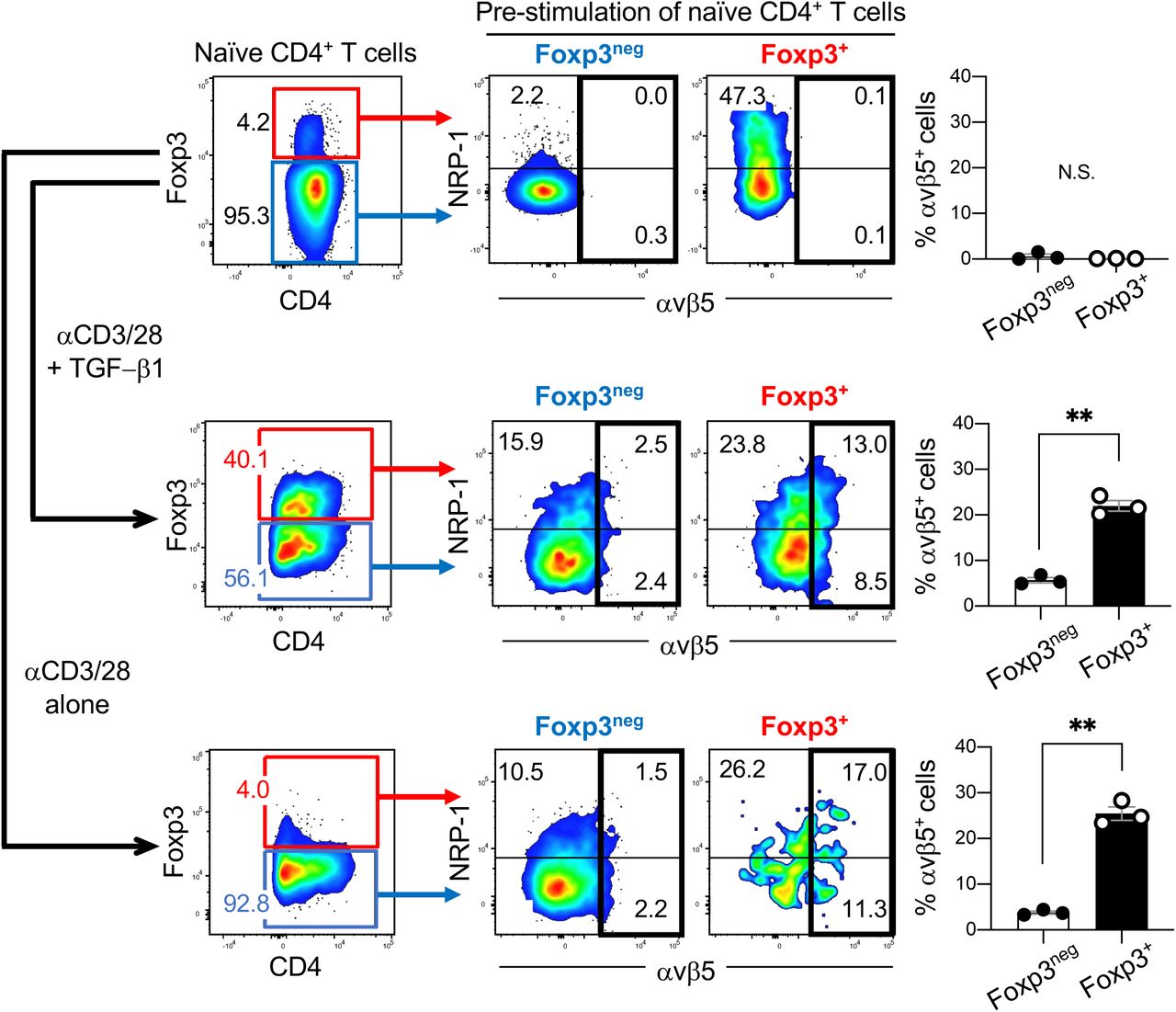
    Naïve CD4 + T cells were isolated from the spleens of healthy C57B6129SF1/J hybrid mice by magnetically removing CD4 neg T cells and CD25 + T cells. The pool enriched for naïve CD4 + T cells was cultured in vitro with anti-CD3/CD28 Abs in the presence or absence of TGF-β1 for 3 days, and analyzed for αvβ5 integrin and NRP-1 expression by flow cytometry. ( Top row) Naïve CD4 + T cells (blue box) enriched from mouse splenocytes. A minor population of CD4 + Foxp3 + T cells was present (red box). ( Middle row ) Treating the pool in the top row with anti-CD3/CD28 Abs and TGF-β1 yielded approximately 40% of CD4 + Foxp3 + T cells (red box) and 56% of CD4 + Foxp3 neg T cells (blue box). ( Bottom row ) Treating the pool in the top row with anti-CD3/CD28 Abs alone did not change the proportion of the CD4 + T cells. Nearly 95% of the cells remained negative for Foxp3 (blue box). Representative dot plots showing the proportion of CD4 + Foxp3 + T cells (left panels) and the expression of αvβ5 integrin and NRP-1 on the indicated population are presented. The bar diagrams summarize the proportion of αvβ5 + cells in the indicated population. n = 3 per study. Statistical analysis, Welch’s t test; p = 0.4115 (top), p = 0.0013 (middle), p = 0.0032 (bottom). Error bars, mean ± standard error; ** p < 0.01; N.S., not significant.

    Journal: bioRxiv

    Article Title: Tumor-resident regulatory T cells in pancreatic cancer express the αvβ5 integrin as a targetable activation marker

    doi: 10.1101/2023.05.24.542137

    Figure Lengend Snippet: Naïve CD4 + T cells were isolated from the spleens of healthy C57B6129SF1/J hybrid mice by magnetically removing CD4 neg T cells and CD25 + T cells. The pool enriched for naïve CD4 + T cells was cultured in vitro with anti-CD3/CD28 Abs in the presence or absence of TGF-β1 for 3 days, and analyzed for αvβ5 integrin and NRP-1 expression by flow cytometry. ( Top row) Naïve CD4 + T cells (blue box) enriched from mouse splenocytes. A minor population of CD4 + Foxp3 + T cells was present (red box). ( Middle row ) Treating the pool in the top row with anti-CD3/CD28 Abs and TGF-β1 yielded approximately 40% of CD4 + Foxp3 + T cells (red box) and 56% of CD4 + Foxp3 neg T cells (blue box). ( Bottom row ) Treating the pool in the top row with anti-CD3/CD28 Abs alone did not change the proportion of the CD4 + T cells. Nearly 95% of the cells remained negative for Foxp3 (blue box). Representative dot plots showing the proportion of CD4 + Foxp3 + T cells (left panels) and the expression of αvβ5 integrin and NRP-1 on the indicated population are presented. The bar diagrams summarize the proportion of αvβ5 + cells in the indicated population. n = 3 per study. Statistical analysis, Welch’s t test; p = 0.4115 (top), p = 0.0013 (middle), p = 0.0032 (bottom). Error bars, mean ± standard error; ** p < 0.01; N.S., not significant.

    Article Snippet: After treating them with IHC Antigen Retrieval Solution (00-4956-58, Invitrogen), the sections were stained with an anti-human CD4 Ab that was pre-labeled with Alexa Fluor 488 using an Ab labeling kit (Molecular Probes, A20187), anti-human/mouse Foxp3 Ab pre-labeled with Alexa Fluor 555 (Molecular Probes, A20181), Alexa Fluor® 647-conjugated anti-mouse integrin αvβ5 Ab, anti-human NRP-1 Ab (AD5-17F6; Milteny Biotec) pre-labeled with Alexa Fluor 647 (Molecular Probes, A20186), and DAPI.

    Techniques: Isolation, Cell Culture, In Vitro, Expressing, Flow Cytometry

    a, b Naïve CD4 + T cells isolated from healthy mouse spleens were expanded in the presence of anti-CD3/CD28 Abs and TGF-β1 ( a ) or anti-CD3/CD28 Abs alone ( b ) for 3 days. The resulting populations were gated based on Foxp3 and CD25 expression (left panels). αvβ5 integrin and NRP-1 expression on Foxp3 + cells ( a , top row) and Foxp3 neg cells ( a , bottom row; b ) was analyzed by flow cytometry. The red and blue boxes gate CD25 + and CD25 neg cells, respectively. The bar diagrams summarize the proportion of αvβ5 integrin-positive cells in the indicated T cell population. n = 3. Statistical analysis, Welch’s t test; p = 0.0021 ( a , top), p = 0.0014 ( a , bottom), p < 0.0001 ( b ). c Flow cytometric analysis showing the proportion of αvβ5 integrin + cells among CD4 + CD25 + Foxp3 + iTregs induced by increasing concentrations of anti-CD3 Ab. n = 3. Statistical analysis, one-way ANOVA; p = 0.0088 (1 vs 3), p = 0.0088 (1 vs 10). d-f Naïve CD4 + T cells were stimulated with anti-CD3/CD28 Abs and TGF-β1 in the absence or presence of iRGD or iRGE. Flow cytometry was performed to quantify the proportion of CD4 + CD25 + Foxp3 + iTregs ( d ) and αvβ5 integrin + cells among the iTregs ( e ). Apoptosis of αvβ5 integrin + iTregs was quantified by measuring cleaved caspase 3 using flow cytometry ( f ). n = 3. Statistical analysis, one-way ANOVA ( d , e ) or Welch’s t test ( f ); p = 0.0042 ( d , None vs iRGD), p = 0.1774 ( d , None vs iRGE), p = 0.0027 ( e , None vs iRGD), p = 0.0529 ( e , None vs iRGE), p = 0.001 ( f ). Error bars, mean ± standard error; * p < 0.05; ** p < 0.01; **** p < 0.0001; N.S., not significant.

    Journal: bioRxiv

    Article Title: Tumor-resident regulatory T cells in pancreatic cancer express the αvβ5 integrin as a targetable activation marker

    doi: 10.1101/2023.05.24.542137

    Figure Lengend Snippet: a, b Naïve CD4 + T cells isolated from healthy mouse spleens were expanded in the presence of anti-CD3/CD28 Abs and TGF-β1 ( a ) or anti-CD3/CD28 Abs alone ( b ) for 3 days. The resulting populations were gated based on Foxp3 and CD25 expression (left panels). αvβ5 integrin and NRP-1 expression on Foxp3 + cells ( a , top row) and Foxp3 neg cells ( a , bottom row; b ) was analyzed by flow cytometry. The red and blue boxes gate CD25 + and CD25 neg cells, respectively. The bar diagrams summarize the proportion of αvβ5 integrin-positive cells in the indicated T cell population. n = 3. Statistical analysis, Welch’s t test; p = 0.0021 ( a , top), p = 0.0014 ( a , bottom), p < 0.0001 ( b ). c Flow cytometric analysis showing the proportion of αvβ5 integrin + cells among CD4 + CD25 + Foxp3 + iTregs induced by increasing concentrations of anti-CD3 Ab. n = 3. Statistical analysis, one-way ANOVA; p = 0.0088 (1 vs 3), p = 0.0088 (1 vs 10). d-f Naïve CD4 + T cells were stimulated with anti-CD3/CD28 Abs and TGF-β1 in the absence or presence of iRGD or iRGE. Flow cytometry was performed to quantify the proportion of CD4 + CD25 + Foxp3 + iTregs ( d ) and αvβ5 integrin + cells among the iTregs ( e ). Apoptosis of αvβ5 integrin + iTregs was quantified by measuring cleaved caspase 3 using flow cytometry ( f ). n = 3. Statistical analysis, one-way ANOVA ( d , e ) or Welch’s t test ( f ); p = 0.0042 ( d , None vs iRGD), p = 0.1774 ( d , None vs iRGE), p = 0.0027 ( e , None vs iRGD), p = 0.0529 ( e , None vs iRGE), p = 0.001 ( f ). Error bars, mean ± standard error; * p < 0.05; ** p < 0.01; **** p < 0.0001; N.S., not significant.

    Article Snippet: After treating them with IHC Antigen Retrieval Solution (00-4956-58, Invitrogen), the sections were stained with an anti-human CD4 Ab that was pre-labeled with Alexa Fluor 488 using an Ab labeling kit (Molecular Probes, A20187), anti-human/mouse Foxp3 Ab pre-labeled with Alexa Fluor 555 (Molecular Probes, A20181), Alexa Fluor® 647-conjugated anti-mouse integrin αvβ5 Ab, anti-human NRP-1 Ab (AD5-17F6; Milteny Biotec) pre-labeled with Alexa Fluor 647 (Molecular Probes, A20186), and DAPI.

    Techniques: Isolation, Expressing, Flow Cytometry

    a CD4 + CD25 + Foxp3 + T cells (nTregs) were enriched from the spleens of healthy C57B6129SF1/J hybrid mice by magnetically removing CD4 neg T cells and CD25 neg T cells. The middle two panels show the expression of αvβ5 integrin and NRP-1 on the nTregs (red box) and naïve CD4 + CD25 neg Foxp3 neg T cells (blue box) analyzed by flow cytometry. The bar diagram summarizes the proportion of αvβ5 integrin + cells among the two populations. n = 3. Statistical analysis, Welch’s t test; p = 0.4721. b The pool in ( a ) was treated with anti-CD3/CD28 Abs alone for 3 days (left panel). αvβ5 integrin and NRP-1 expression on Foxp3 + cells (top row) and Foxp3 neg cells (bottom row) was analyzed by flow cytometry. The red and blue boxes gate CD25 + and CD25 neg cells, respectively. The bar diagrams summarize the proportion of αvβ5 integrin + cells among the indicated T cell populations. n = 3. Statistical analysis, Welch’s t test; p = 0.0064 (top), p = 0.0035 (bottom). Error bars, mean ± standard error; ** p < 0.01; N.S., not significant.

    Journal: bioRxiv

    Article Title: Tumor-resident regulatory T cells in pancreatic cancer express the αvβ5 integrin as a targetable activation marker

    doi: 10.1101/2023.05.24.542137

    Figure Lengend Snippet: a CD4 + CD25 + Foxp3 + T cells (nTregs) were enriched from the spleens of healthy C57B6129SF1/J hybrid mice by magnetically removing CD4 neg T cells and CD25 neg T cells. The middle two panels show the expression of αvβ5 integrin and NRP-1 on the nTregs (red box) and naïve CD4 + CD25 neg Foxp3 neg T cells (blue box) analyzed by flow cytometry. The bar diagram summarizes the proportion of αvβ5 integrin + cells among the two populations. n = 3. Statistical analysis, Welch’s t test; p = 0.4721. b The pool in ( a ) was treated with anti-CD3/CD28 Abs alone for 3 days (left panel). αvβ5 integrin and NRP-1 expression on Foxp3 + cells (top row) and Foxp3 neg cells (bottom row) was analyzed by flow cytometry. The red and blue boxes gate CD25 + and CD25 neg cells, respectively. The bar diagrams summarize the proportion of αvβ5 integrin + cells among the indicated T cell populations. n = 3. Statistical analysis, Welch’s t test; p = 0.0064 (top), p = 0.0035 (bottom). Error bars, mean ± standard error; ** p < 0.01; N.S., not significant.

    Article Snippet: After treating them with IHC Antigen Retrieval Solution (00-4956-58, Invitrogen), the sections were stained with an anti-human CD4 Ab that was pre-labeled with Alexa Fluor 488 using an Ab labeling kit (Molecular Probes, A20187), anti-human/mouse Foxp3 Ab pre-labeled with Alexa Fluor 555 (Molecular Probes, A20181), Alexa Fluor® 647-conjugated anti-mouse integrin αvβ5 Ab, anti-human NRP-1 Ab (AD5-17F6; Milteny Biotec) pre-labeled with Alexa Fluor 647 (Molecular Probes, A20186), and DAPI.

    Techniques: Expressing, Flow Cytometry

    Naïve CD4 + CD25 neg Foxp3 neg T cells were magnetically isolated from the spleens of healthy C57B6129SF1/J mice. The cells were stimulated with anti-CD3/CD28 Abs and TGF-β1 for 3 days to induce CD4 + CD25 + Foxp3 + iTregs. a-c Expression of CCR8 and αvβ5 integrin on the T cells before and after the stimulation. Representative dot plots from 3 or 4 separate studies are shown in ( a ). The bar diagram in ( b ) summarizes the proportion of CCR8 + cells (white bars) and αvβ5 integrin + cells (black bars) among each T cell population in ( a ). The Venn diagram in ( c ) summarizes the proportion of iTregs that expressed CCR8 and/or αvβ5 integrin. d-f Treg suppression assays were performed by co-culturing iTregs and Tconv (CD4 + and CD8 + ) at a 1 : 4 ratio in the presence of anti-CD3/CD28 Abs (TCR stimulation) for 3 days. We used iTregs that were enriched for CCR8 + iTregs ( d ) or CCR8 + iTregs that were either depleted or enriched for αvβ5 integrin + cells ( e ). The expression of CCR8 and αvβ5 integrin on the iTregs is shown in the representative dot plots. Proliferation of Tconv was analyzed by flow cytometry using Cell Trace Violet as shown in the representative histograms: Shaded, iTregs + Tconv (with TCR stimulation); black solid line, Tconv alone (with TCR stimulation); black dotted line, Tconv alone (no TCR stimulation). The bar diagrams in ( f ) summarize the values from ( d ) and ( e ) normalized to stimulated Tconv alone. n = 3. Statistical analysis, one-way ANOVA; p < 0.0001 ( b , CCR8 + , CD25 neg Foxp3 neg vs CD25 + Foxp3 neg and CD25 + Foxp3 neg vs CD25 + Foxp3 + ; αvβ5 + , CD25 + Foxp3 neg vs CD25 + Foxp3 + ), p = 0.0989 ( b , αvβ5 + , CD25 neg Foxp3 neg vs CD25 + Foxp3 neg ), p = 0.0003 ( f , CD4, CCR8 + vs αvβ5 neg CCR8 + ), p = 0.0002 ( f , CD4, CCR8 + vs αvβ5 + CCR8 + ), p < 0.0001 ( f , CD4, αvβ5 neg CCR8 + vs αvβ5 + CCR8 + ), p = 0.1048 ( f , CD8, CCR8 + vs αvβ5 neg CCR8 + ), p < 0.0001 ( f , CD8, CCR8 + vs αvβ5 + CCR8 + and αvβ5 neg CCR8 + vs αvβ5 + CCR8 + ). Error bars, mean ± standard error; *** p < 0.001; **** p < 0.0001; N.S., not significant.

    Journal: bioRxiv

    Article Title: Tumor-resident regulatory T cells in pancreatic cancer express the αvβ5 integrin as a targetable activation marker

    doi: 10.1101/2023.05.24.542137

    Figure Lengend Snippet: Naïve CD4 + CD25 neg Foxp3 neg T cells were magnetically isolated from the spleens of healthy C57B6129SF1/J mice. The cells were stimulated with anti-CD3/CD28 Abs and TGF-β1 for 3 days to induce CD4 + CD25 + Foxp3 + iTregs. a-c Expression of CCR8 and αvβ5 integrin on the T cells before and after the stimulation. Representative dot plots from 3 or 4 separate studies are shown in ( a ). The bar diagram in ( b ) summarizes the proportion of CCR8 + cells (white bars) and αvβ5 integrin + cells (black bars) among each T cell population in ( a ). The Venn diagram in ( c ) summarizes the proportion of iTregs that expressed CCR8 and/or αvβ5 integrin. d-f Treg suppression assays were performed by co-culturing iTregs and Tconv (CD4 + and CD8 + ) at a 1 : 4 ratio in the presence of anti-CD3/CD28 Abs (TCR stimulation) for 3 days. We used iTregs that were enriched for CCR8 + iTregs ( d ) or CCR8 + iTregs that were either depleted or enriched for αvβ5 integrin + cells ( e ). The expression of CCR8 and αvβ5 integrin on the iTregs is shown in the representative dot plots. Proliferation of Tconv was analyzed by flow cytometry using Cell Trace Violet as shown in the representative histograms: Shaded, iTregs + Tconv (with TCR stimulation); black solid line, Tconv alone (with TCR stimulation); black dotted line, Tconv alone (no TCR stimulation). The bar diagrams in ( f ) summarize the values from ( d ) and ( e ) normalized to stimulated Tconv alone. n = 3. Statistical analysis, one-way ANOVA; p < 0.0001 ( b , CCR8 + , CD25 neg Foxp3 neg vs CD25 + Foxp3 neg and CD25 + Foxp3 neg vs CD25 + Foxp3 + ; αvβ5 + , CD25 + Foxp3 neg vs CD25 + Foxp3 + ), p = 0.0989 ( b , αvβ5 + , CD25 neg Foxp3 neg vs CD25 + Foxp3 neg ), p = 0.0003 ( f , CD4, CCR8 + vs αvβ5 neg CCR8 + ), p = 0.0002 ( f , CD4, CCR8 + vs αvβ5 + CCR8 + ), p < 0.0001 ( f , CD4, αvβ5 neg CCR8 + vs αvβ5 + CCR8 + ), p = 0.1048 ( f , CD8, CCR8 + vs αvβ5 neg CCR8 + ), p < 0.0001 ( f , CD8, CCR8 + vs αvβ5 + CCR8 + and αvβ5 neg CCR8 + vs αvβ5 + CCR8 + ). Error bars, mean ± standard error; *** p < 0.001; **** p < 0.0001; N.S., not significant.

    Article Snippet: After treating them with IHC Antigen Retrieval Solution (00-4956-58, Invitrogen), the sections were stained with an anti-human CD4 Ab that was pre-labeled with Alexa Fluor 488 using an Ab labeling kit (Molecular Probes, A20187), anti-human/mouse Foxp3 Ab pre-labeled with Alexa Fluor 555 (Molecular Probes, A20181), Alexa Fluor® 647-conjugated anti-mouse integrin αvβ5 Ab, anti-human NRP-1 Ab (AD5-17F6; Milteny Biotec) pre-labeled with Alexa Fluor 647 (Molecular Probes, A20186), and DAPI.

    Techniques: Isolation, Expressing, Flow Cytometry

    Hemorrhage resulted in the reduction of integrin αvβ5 protein in muscles. A: Hemorrhage protocol; B: Hemorrhage caused a decrease in integrin αvβ5; C: Densitometric analysis of integrin αvβ5 protein in muscle. Data are shown as Mean ± SEM ( n = 3/each group); **p < 0.01.

    Journal: Experimental and molecular pathology

    Article Title: Inhibition of integrin alpha v/beta 5 mitigates the protective effect induced by irisin in hemorrhage

    doi: 10.1016/j.yexmp.2023.104869

    Figure Lengend Snippet: Hemorrhage resulted in the reduction of integrin αvβ5 protein in muscles. A: Hemorrhage protocol; B: Hemorrhage caused a decrease in integrin αvβ5; C: Densitometric analysis of integrin αvβ5 protein in muscle. Data are shown as Mean ± SEM ( n = 3/each group); **p < 0.01.

    Article Snippet: After blocking, the slide sections were incubated with anti-mouse integrin αvβ5 (Abcam) and anti mouse α sarcomeric actin IgM (Millipore-Sigma) (1:200) overnight at 4 °C.

    Techniques: Muscles

    Binding of Irisin to integrin αvβ5 in vitro: A: Establishment of stable cell line overexpressing Integrin αvβ5 in embryonic stem cells (ESC)Nkx2.5 + cell. B: ELISA (Enzyme-linked immunosorbent assay) was performed to verify the direct binding of irisin binding to integrin αvβ5. Embryonic Nkx2.5+ESCs stable cells over-expressed integrin αvβ5 or wilt type cells were used to see the increased irisin binding to integrin αvβ5. The binding assay for detecting integrin αvβ5 and irisin were carried out using ELISA. Data are shown as Mean ± SEM, n = 5/each group.

    Journal: Experimental and molecular pathology

    Article Title: Inhibition of integrin alpha v/beta 5 mitigates the protective effect induced by irisin in hemorrhage

    doi: 10.1016/j.yexmp.2023.104869

    Figure Lengend Snippet: Binding of Irisin to integrin αvβ5 in vitro: A: Establishment of stable cell line overexpressing Integrin αvβ5 in embryonic stem cells (ESC)Nkx2.5 + cell. B: ELISA (Enzyme-linked immunosorbent assay) was performed to verify the direct binding of irisin binding to integrin αvβ5. Embryonic Nkx2.5+ESCs stable cells over-expressed integrin αvβ5 or wilt type cells were used to see the increased irisin binding to integrin αvβ5. The binding assay for detecting integrin αvβ5 and irisin were carried out using ELISA. Data are shown as Mean ± SEM, n = 5/each group.

    Article Snippet: After blocking, the slide sections were incubated with anti-mouse integrin αvβ5 (Abcam) and anti mouse α sarcomeric actin IgM (Millipore-Sigma) (1:200) overnight at 4 °C.

    Techniques: Binding Assay, In Vitro, Stable Transfection, Enzyme-linked Immunosorbent Assay

    Characterization of Gold-CRISPR/Cas9-sgRNA delivery system. A: the sequence of sgRNA of integrin β- 5. B: Gold-nano-CRISPR/Cas-9 delivery design and components; C: Stability assessment by measuring of zeta potential of CRISPR/Cas-9 sgRNA integrin β- 5 delivery with dynamic light scattering (DLS); D: Size distribution of CRISPR/Cas-9 sgRNA integrin β- 5; E&F: In vitro knockdown of integrin β- 5 mRNA by Gold-CRISPR system and shRNA targeting integrin β- 5 in embryonic stem cells (Nkx2.5+ ESCs) ( n = 5/per group). ***p < 0.001; G: Diagram of delivery Gold-CRISPR system was injected to mice and skeletal muscle was harvested at 2 weeks of delivery; H: Immunostaining detecting of i ntegrin β- 5. I: mRNA of i ntegrin β- 5; J: Body weight; Data were expressed as Mean ± SE ( n = 4–5/per group).

    Journal: Experimental and molecular pathology

    Article Title: Inhibition of integrin alpha v/beta 5 mitigates the protective effect induced by irisin in hemorrhage

    doi: 10.1016/j.yexmp.2023.104869

    Figure Lengend Snippet: Characterization of Gold-CRISPR/Cas9-sgRNA delivery system. A: the sequence of sgRNA of integrin β- 5. B: Gold-nano-CRISPR/Cas-9 delivery design and components; C: Stability assessment by measuring of zeta potential of CRISPR/Cas-9 sgRNA integrin β- 5 delivery with dynamic light scattering (DLS); D: Size distribution of CRISPR/Cas-9 sgRNA integrin β- 5; E&F: In vitro knockdown of integrin β- 5 mRNA by Gold-CRISPR system and shRNA targeting integrin β- 5 in embryonic stem cells (Nkx2.5+ ESCs) ( n = 5/per group). ***p < 0.001; G: Diagram of delivery Gold-CRISPR system was injected to mice and skeletal muscle was harvested at 2 weeks of delivery; H: Immunostaining detecting of i ntegrin β- 5. I: mRNA of i ntegrin β- 5; J: Body weight; Data were expressed as Mean ± SE ( n = 4–5/per group).

    Article Snippet: After blocking, the slide sections were incubated with anti-mouse integrin αvβ5 (Abcam) and anti mouse α sarcomeric actin IgM (Millipore-Sigma) (1:200) overnight at 4 °C.

    Techniques: CRISPR, Sequencing, Zeta Potential Analyzer, In Vitro, shRNA, Injection, Immunostaining

    The MAP in mice exposed to hemorrhage following ITGB5 knockdown: Time course and MAP during the hemorrhagic shock period. A: The time course of MAP during the hemorrhage; B: MAP of animals before hemorrhage; C: MAP of animals at 20 min of resuscitation: Data are shown as Mean ± SEM ( n = 4–6/each group), *p < 0.05; **p < 0.01. ITGB5: integrin β- 5. KD: knockdown.

    Journal: Experimental and molecular pathology

    Article Title: Inhibition of integrin alpha v/beta 5 mitigates the protective effect induced by irisin in hemorrhage

    doi: 10.1016/j.yexmp.2023.104869

    Figure Lengend Snippet: The MAP in mice exposed to hemorrhage following ITGB5 knockdown: Time course and MAP during the hemorrhagic shock period. A: The time course of MAP during the hemorrhage; B: MAP of animals before hemorrhage; C: MAP of animals at 20 min of resuscitation: Data are shown as Mean ± SEM ( n = 4–6/each group), *p < 0.05; **p < 0.01. ITGB5: integrin β- 5. KD: knockdown.

    Article Snippet: After blocking, the slide sections were incubated with anti-mouse integrin αvβ5 (Abcam) and anti mouse α sarcomeric actin IgM (Millipore-Sigma) (1:200) overnight at 4 °C.

    Techniques:

    αvβ5-integrin and chondroitin sulfate proteoglycans are implicated in Wnt1-inducible signaling protein 1 (WISP1)-induced production of migration inhibitory factor (MIF) from human lung fibroblasts (HLFs). HLFs were pretreated for 30 minutes with anti-αvβ5-integrin antibody (6 µg/mL) ( A ) or for 2 h with chondroitinase ABC or chondroitinase AC II (3 units/mL) ( B ), followed by stimulation with WISP1 (100 ng/mL) for 48 h, and the levels of MIF in conditioned media were determined by ELISA. Data represent the means ± SD ( n = 3). *Statistically significant increase ( P < 0.05) compared to control. #Statistically significant decrease ( P < 0.05) compared to WISP1-treated cells. IgG represents immunoglobulins from nonimmunized mouse.

    Journal: American Journal of Physiology - Cell Physiology

    Article Title: WISP1 induces the expression of macrophage migration inhibitory factor in human lung fibroblasts through Src kinases and EGFR-activated signaling pathways

    doi: 10.1152/ajpcell.00410.2023

    Figure Lengend Snippet: αvβ5-integrin and chondroitin sulfate proteoglycans are implicated in Wnt1-inducible signaling protein 1 (WISP1)-induced production of migration inhibitory factor (MIF) from human lung fibroblasts (HLFs). HLFs were pretreated for 30 minutes with anti-αvβ5-integrin antibody (6 µg/mL) ( A ) or for 2 h with chondroitinase ABC or chondroitinase AC II (3 units/mL) ( B ), followed by stimulation with WISP1 (100 ng/mL) for 48 h, and the levels of MIF in conditioned media were determined by ELISA. Data represent the means ± SD ( n = 3). *Statistically significant increase ( P < 0.05) compared to control. #Statistically significant decrease ( P < 0.05) compared to WISP1-treated cells. IgG represents immunoglobulins from nonimmunized mouse.

    Article Snippet: Recombinant human EGF and anti-integrin αvβ5 mouse mAb (no. MAB2528-SP) were purchased from R&D Systems (Bio-Techne Ltd., Abingdon, UK).

    Techniques: Migration, Enzyme-linked Immunosorbent Assay, Control

    Proposed model of the effects of Wnt1-inducible signaling protein 1 (WISP1) on the expression of migration inhibitory factor (MIF) and its receptors, as well as on the expression of cyclooxygenase (COX)-2, IL-6, and matrix metalloproteinase (MMP)-2, and production of prostaglandin E 2 (PGE 2 ) from human lung fibroblasts (HLFs). The effect of WISP-1 on the expression of MIF in HLFs with the complex interactions between WISP-1, αvβ5, Src kinases, EGF receptor (EGFR), and CD74/CD44 receptors, reveal intricate regulatory networks that could contribute to the expression of proinflamamtory molecules and remodeling enzymes secretion.

    Journal: American Journal of Physiology - Cell Physiology

    Article Title: WISP1 induces the expression of macrophage migration inhibitory factor in human lung fibroblasts through Src kinases and EGFR-activated signaling pathways

    doi: 10.1152/ajpcell.00410.2023

    Figure Lengend Snippet: Proposed model of the effects of Wnt1-inducible signaling protein 1 (WISP1) on the expression of migration inhibitory factor (MIF) and its receptors, as well as on the expression of cyclooxygenase (COX)-2, IL-6, and matrix metalloproteinase (MMP)-2, and production of prostaglandin E 2 (PGE 2 ) from human lung fibroblasts (HLFs). The effect of WISP-1 on the expression of MIF in HLFs with the complex interactions between WISP-1, αvβ5, Src kinases, EGF receptor (EGFR), and CD74/CD44 receptors, reveal intricate regulatory networks that could contribute to the expression of proinflamamtory molecules and remodeling enzymes secretion.

    Article Snippet: Recombinant human EGF and anti-integrin αvβ5 mouse mAb (no. MAB2528-SP) were purchased from R&D Systems (Bio-Techne Ltd., Abingdon, UK).

    Techniques: Expressing, Migration

    ( a ) RFP growth competition assay (used in Figs. , , ): The ipUSEPR vector expresses a sgRNA together with a puromycin-resistant gene (PuroR) and a TagRFP fluorescent protein. The RFP fluorescent signal of live (DAPI – ) singlet cells was detected by an Attune NxT flow cytometer with an HTS autosampler. The sgRNA targeting a functionally important gene will result in a reduced RFP + population in the culture. ( b ) Gating strategy for detecting the cell surface αVβ5 expression (used in Fig. ).

    Journal: Nature Structural & Molecular Biology

    Article Title: A novel class of inhibitors that disrupts the stability of integrin heterodimers identified by CRISPR-tiling-instructed genetic screens

    doi: 10.1038/s41594-024-01211-y

    Figure Lengend Snippet: ( a ) RFP growth competition assay (used in Figs. , , ): The ipUSEPR vector expresses a sgRNA together with a puromycin-resistant gene (PuroR) and a TagRFP fluorescent protein. The RFP fluorescent signal of live (DAPI – ) singlet cells was detected by an Attune NxT flow cytometer with an HTS autosampler. The sgRNA targeting a functionally important gene will result in a reduced RFP + population in the culture. ( b ) Gating strategy for detecting the cell surface αVβ5 expression (used in Fig. ).

    Article Snippet: Cell surface integrin αVβ5 was recognized by a mouse monoclonal anti-human αVβ5 antibody (clone P1F76; sc-13588, Santa Cruz Biotech; 1:200) and stained with AF488-conjugated donkey anti-mouse IgG (ab150105, Abcam) secondary antibody.

    Techniques: Competitive Binding Assay, Plasmid Preparation, Flow Cytometry, Expressing

    a , Model of integrin α (red) and β (blue) subunits and domain structures. The binding site of the extracellular ligand (yellow) is assembled upon heterodimerization of the α/β subunits. b , Schematic outline of integrin family CRISPR screens (712 sgRNAs) in Cas9-expressing MDA231 and PANC1 cells. c , Fold change of each sgRNA from day 0 to day 24 in MDA231-Cas9 + ( x axis) and PANC1-Cas9 + ( y axis) cells. The sgRNAs targeting ITGAV (red dots), ITGB5 (blue dots), positive controls (yellow triangles), negative controls (green triangles) and the total library (gray dots) are indicated. d , Heatmap showing CRISPR impact scores (median log 10 fold change of 25 sgRNAs) of each integrin subunit in the integrin network consisting of 24 distinct integrin α/β heterodimers. The solid lines indicate the integrin α/β pairs forming the RGD receptors (yellow), collagen receptors (pink), laminin receptors (brown) and leukocyte-specific receptors (green). The red dotted circle highlights αVβ5 as the top essential integrin heterodimer in cancer cells. e , Growth competition assay of MDA231-Cas9 + cells transduced with RFP-labeled sgCtrl (gray lines; two independent sgRNA sequences) and sgITGB1/3/5/6/8 (blue lines; three independent sgRNA sequences for each gene). Asterisk indicates that all three sgRNAs for each ITGB gene group were significantly different ( P < 0.01) from the two sgCtrl groups ( n = 3 for each group). f , Western blot of ITGB5 and β-actin in MDA231-Cas9 + cells transduced with sgCtrl ( n = 2 independent sgRNA sequences) and sgITGB5 ( n = 3 independent sgRNA sequences) for 3 days. g , h , Cellular apoptosis detected by Annexin V + /DAPI − ( g ) and cell cycle monitored by EdU incorporation ( h ) in MDA231-Cas9 + cells transduced with sgCtrl and sgITGB5 for 3 days ( n = 3 for each group). i , Gene ranking based on the Pearson coefficient ( r ) of CERES scores between ITGAV and ITGB5 (blue) compared with other ITGAV partner β subunit genes ITGB1 / 3 / 6 / 8 (yellow) in the 769 tested cell models (Extended Data Fig. ). Data are presented as the mean ± s.e.m. P values were calculated by two-sided Student’s t -test.

    Journal: Nature Structural & Molecular Biology

    Article Title: A novel class of inhibitors that disrupts the stability of integrin heterodimers identified by CRISPR-tiling-instructed genetic screens

    doi: 10.1038/s41594-024-01211-y

    Figure Lengend Snippet: a , Model of integrin α (red) and β (blue) subunits and domain structures. The binding site of the extracellular ligand (yellow) is assembled upon heterodimerization of the α/β subunits. b , Schematic outline of integrin family CRISPR screens (712 sgRNAs) in Cas9-expressing MDA231 and PANC1 cells. c , Fold change of each sgRNA from day 0 to day 24 in MDA231-Cas9 + ( x axis) and PANC1-Cas9 + ( y axis) cells. The sgRNAs targeting ITGAV (red dots), ITGB5 (blue dots), positive controls (yellow triangles), negative controls (green triangles) and the total library (gray dots) are indicated. d , Heatmap showing CRISPR impact scores (median log 10 fold change of 25 sgRNAs) of each integrin subunit in the integrin network consisting of 24 distinct integrin α/β heterodimers. The solid lines indicate the integrin α/β pairs forming the RGD receptors (yellow), collagen receptors (pink), laminin receptors (brown) and leukocyte-specific receptors (green). The red dotted circle highlights αVβ5 as the top essential integrin heterodimer in cancer cells. e , Growth competition assay of MDA231-Cas9 + cells transduced with RFP-labeled sgCtrl (gray lines; two independent sgRNA sequences) and sgITGB1/3/5/6/8 (blue lines; three independent sgRNA sequences for each gene). Asterisk indicates that all three sgRNAs for each ITGB gene group were significantly different ( P < 0.01) from the two sgCtrl groups ( n = 3 for each group). f , Western blot of ITGB5 and β-actin in MDA231-Cas9 + cells transduced with sgCtrl ( n = 2 independent sgRNA sequences) and sgITGB5 ( n = 3 independent sgRNA sequences) for 3 days. g , h , Cellular apoptosis detected by Annexin V + /DAPI − ( g ) and cell cycle monitored by EdU incorporation ( h ) in MDA231-Cas9 + cells transduced with sgCtrl and sgITGB5 for 3 days ( n = 3 for each group). i , Gene ranking based on the Pearson coefficient ( r ) of CERES scores between ITGAV and ITGB5 (blue) compared with other ITGAV partner β subunit genes ITGB1 / 3 / 6 / 8 (yellow) in the 769 tested cell models (Extended Data Fig. ). Data are presented as the mean ± s.e.m. P values were calculated by two-sided Student’s t -test.

    Article Snippet: Cell surface integrin αVβ5 was recognized by a mouse monoclonal anti-human αVβ5 antibody (clone P1F76; sc-13588, Santa Cruz Biotech; 1:200) and stained with AF488-conjugated donkey anti-mouse IgG (ab150105, Abcam) secondary antibody.

    Techniques: Binding Assay, CRISPR, Expressing, Competitive Binding Assay, Transduction, Labeling, Western Blot

    a , 3D ‘docking box’ (cube) defined by the CRISPR-hypersensitive regions (numbers 1–7) within the ITGAV β-propeller domain. b , Compound (Cpd) ranking based on free binding energy (ΔG°) to the ‘docking box’ within the β-propeller domain predicted by AutoDock Vina. c , d , Heatmap showing relative CellTiter Glo (left) and CCK8 (right) signals (percentage of the signal for dimethyl sulfoxide; DMSO) in MDA231 cells incubated with 10 µM of 500 selected compounds ( c ) and the top nine effective compounds ( d ) for 3 days. Effective cell killing was defined as less than 10% relative signals for both CellTiter Glo and CCK8 assays. e , Schematic outline of flow cytometric measurement of cell surface integrin αVβ5 using a monoclonal antibody against integrin αVβ5 heterodimers. f , Effects of the top nine candidate compounds on cell surface integrin αVβ5 levels upon 1 h compound treatments ( n = 4 for each condition). g , h , Cellular apoptosis detected by Annexin V + /DAPI − ( g ) and cell cycle monitored by EdU incorporation ( h ) in MDA231 cells treated with Cpd_AV2 (40 µM) for 0 to 3 h ( n = 3 for each time point). i , Representative fluorescence images of F-actin (FITC, green) and nucleus (DAPI, blue) staining in MDA231 cells treated with control (DMSO) and Cpd_AV2 (40 µM) for 10 min. Scale bars, 20 µm. j , Violin plot showing the distribution of cell size (µm 2 ) in MDA231 cells treated with control (DMSO) and Cpd_AV2 (40 µM) for 10 min. Data are presented as the mean ± s.e.m. P values were calculated by two-sided Student’s t -test.

    Journal: Nature Structural & Molecular Biology

    Article Title: A novel class of inhibitors that disrupts the stability of integrin heterodimers identified by CRISPR-tiling-instructed genetic screens

    doi: 10.1038/s41594-024-01211-y

    Figure Lengend Snippet: a , 3D ‘docking box’ (cube) defined by the CRISPR-hypersensitive regions (numbers 1–7) within the ITGAV β-propeller domain. b , Compound (Cpd) ranking based on free binding energy (ΔG°) to the ‘docking box’ within the β-propeller domain predicted by AutoDock Vina. c , d , Heatmap showing relative CellTiter Glo (left) and CCK8 (right) signals (percentage of the signal for dimethyl sulfoxide; DMSO) in MDA231 cells incubated with 10 µM of 500 selected compounds ( c ) and the top nine effective compounds ( d ) for 3 days. Effective cell killing was defined as less than 10% relative signals for both CellTiter Glo and CCK8 assays. e , Schematic outline of flow cytometric measurement of cell surface integrin αVβ5 using a monoclonal antibody against integrin αVβ5 heterodimers. f , Effects of the top nine candidate compounds on cell surface integrin αVβ5 levels upon 1 h compound treatments ( n = 4 for each condition). g , h , Cellular apoptosis detected by Annexin V + /DAPI − ( g ) and cell cycle monitored by EdU incorporation ( h ) in MDA231 cells treated with Cpd_AV2 (40 µM) for 0 to 3 h ( n = 3 for each time point). i , Representative fluorescence images of F-actin (FITC, green) and nucleus (DAPI, blue) staining in MDA231 cells treated with control (DMSO) and Cpd_AV2 (40 µM) for 10 min. Scale bars, 20 µm. j , Violin plot showing the distribution of cell size (µm 2 ) in MDA231 cells treated with control (DMSO) and Cpd_AV2 (40 µM) for 10 min. Data are presented as the mean ± s.e.m. P values were calculated by two-sided Student’s t -test.

    Article Snippet: Cell surface integrin αVβ5 was recognized by a mouse monoclonal anti-human αVβ5 antibody (clone P1F76; sc-13588, Santa Cruz Biotech; 1:200) and stained with AF488-conjugated donkey anti-mouse IgG (ab150105, Abcam) secondary antibody.

    Techniques: CRISPR, Binding Assay, Incubation, Fluorescence, Staining, Control

    a , Purification of bacterial-expressed recombinant ITGAV β-propeller domain (peptide region 31–492 aa; N-terminal His 6 -tagged) using immobilized metal affinity chromatography (IMAC) and anion exchange chromatography (IEX). The input and purified ITGAV β-propeller domain samples were visualized by gel electrophoresis and silver staining (right; gel representative of two independent protein purification experiments). b , Protein thermal stability as estimated by fluorescent dye incorporation of the purified ITGAV β-propeller domain under control (DMSO) and Cpd_AV2 (40 µM) conditions. c , Protein surface model (left) showing a docking simulation of the ITGAV β-propeller domain (colored by NCS) interacting with Cpd_AV2 (yellow). Protein ribbon model (right) illustrates an overlap of ITGB5 lysine 287 (within βA loop; cyan) and Cpd_AV2 (yellow) binding on the β-propeller HIP of ITGAV. d , e , Effects of cilengitide and Cpd_AV2 on cell surface integrin αVβ5 levels after 1 h treatment ( d ) and cell expansion after 72 h treatment in MDA231 cells ( e ) ( n = 3 for each group). f , Effects of 72 h Cpd_AV2 treatment on expansion of six cancer cell models ( n = 3 for each group). g , Chemical structure of Cpd_AV2 (source: NCI/DTP Open Chemicals Repository). h , Model showing distinct mechanisms of action between Cpd_AV2 (left) and cilengitide (right) for suppressing ECM-to-integrin αVβ5 signaling (middle). Data are presented as the mean ± s.e.m. P values were calculated by two-sided Student’s t -test. NSCLC, nonsmall-cell lung cancer.

    Journal: Nature Structural & Molecular Biology

    Article Title: A novel class of inhibitors that disrupts the stability of integrin heterodimers identified by CRISPR-tiling-instructed genetic screens

    doi: 10.1038/s41594-024-01211-y

    Figure Lengend Snippet: a , Purification of bacterial-expressed recombinant ITGAV β-propeller domain (peptide region 31–492 aa; N-terminal His 6 -tagged) using immobilized metal affinity chromatography (IMAC) and anion exchange chromatography (IEX). The input and purified ITGAV β-propeller domain samples were visualized by gel electrophoresis and silver staining (right; gel representative of two independent protein purification experiments). b , Protein thermal stability as estimated by fluorescent dye incorporation of the purified ITGAV β-propeller domain under control (DMSO) and Cpd_AV2 (40 µM) conditions. c , Protein surface model (left) showing a docking simulation of the ITGAV β-propeller domain (colored by NCS) interacting with Cpd_AV2 (yellow). Protein ribbon model (right) illustrates an overlap of ITGB5 lysine 287 (within βA loop; cyan) and Cpd_AV2 (yellow) binding on the β-propeller HIP of ITGAV. d , e , Effects of cilengitide and Cpd_AV2 on cell surface integrin αVβ5 levels after 1 h treatment ( d ) and cell expansion after 72 h treatment in MDA231 cells ( e ) ( n = 3 for each group). f , Effects of 72 h Cpd_AV2 treatment on expansion of six cancer cell models ( n = 3 for each group). g , Chemical structure of Cpd_AV2 (source: NCI/DTP Open Chemicals Repository). h , Model showing distinct mechanisms of action between Cpd_AV2 (left) and cilengitide (right) for suppressing ECM-to-integrin αVβ5 signaling (middle). Data are presented as the mean ± s.e.m. P values were calculated by two-sided Student’s t -test. NSCLC, nonsmall-cell lung cancer.

    Article Snippet: Cell surface integrin αVβ5 was recognized by a mouse monoclonal anti-human αVβ5 antibody (clone P1F76; sc-13588, Santa Cruz Biotech; 1:200) and stained with AF488-conjugated donkey anti-mouse IgG (ab150105, Abcam) secondary antibody.

    Techniques: Purification, Recombinant, Affinity Chromatography, Chromatography, Nucleic Acid Electrophoresis, Silver Staining, Protein Purification, Control, Binding Assay

    ( a ) 3D structure of the extracellular domain of ITGB5 was modeled by AlphaFold2 (cyan) and overlaid with the ITGB3 portion of integrin αVβ3 structure resolved by Xiong et al. (PDB ID: 3IJE, chain B; blue). Overall, we observed high concordance of the 3D structures between ITGB3 and ITGB5, including the highly conserved basic amino acid (ITGB3’s R287 or ITGB5’s K287) in the loop motif of the βA domain highlighted in ( b ). ( c ) Modeling of ITGAV/ITGB5 interaction using the AlphaFold2 predicted ITGB5 structure (cyan) and the ITGAV portion of integrin αVβ3 structure (PDB ID: 3IJE, chain A; red). ( d and e ) Molecular dynamics simulation using GROMACS 2022 with CHARMM36m force field indicates ( d ) a close contact between ITGB5’s K287 and ITGAV’s β-propeller HIP pocket (purple box), and ( e ) the occupancy of Cpd_AV2 (yellow) into ITGAV’s HIP pocket disengaged the side chain of ITGB5’s K287 from stably interacting with ITGAV. ( f ) Substitution of ITGB5’s K287 with an alanine (K287A) significantly attenuated the ITGAV/ITGB5 NanoBRET signal, highlighting an essential role of this basic residue in integrin αVβ5 assembly (n = 3 for each group). Data are represented as mean ± s.e.m. P value was calculated by two-sided Student’s t-test.

    Journal: Nature Structural & Molecular Biology

    Article Title: A novel class of inhibitors that disrupts the stability of integrin heterodimers identified by CRISPR-tiling-instructed genetic screens

    doi: 10.1038/s41594-024-01211-y

    Figure Lengend Snippet: ( a ) 3D structure of the extracellular domain of ITGB5 was modeled by AlphaFold2 (cyan) and overlaid with the ITGB3 portion of integrin αVβ3 structure resolved by Xiong et al. (PDB ID: 3IJE, chain B; blue). Overall, we observed high concordance of the 3D structures between ITGB3 and ITGB5, including the highly conserved basic amino acid (ITGB3’s R287 or ITGB5’s K287) in the loop motif of the βA domain highlighted in ( b ). ( c ) Modeling of ITGAV/ITGB5 interaction using the AlphaFold2 predicted ITGB5 structure (cyan) and the ITGAV portion of integrin αVβ3 structure (PDB ID: 3IJE, chain A; red). ( d and e ) Molecular dynamics simulation using GROMACS 2022 with CHARMM36m force field indicates ( d ) a close contact between ITGB5’s K287 and ITGAV’s β-propeller HIP pocket (purple box), and ( e ) the occupancy of Cpd_AV2 (yellow) into ITGAV’s HIP pocket disengaged the side chain of ITGB5’s K287 from stably interacting with ITGAV. ( f ) Substitution of ITGB5’s K287 with an alanine (K287A) significantly attenuated the ITGAV/ITGB5 NanoBRET signal, highlighting an essential role of this basic residue in integrin αVβ5 assembly (n = 3 for each group). Data are represented as mean ± s.e.m. P value was calculated by two-sided Student’s t-test.

    Article Snippet: Cell surface integrin αVβ5 was recognized by a mouse monoclonal anti-human αVβ5 antibody (clone P1F76; sc-13588, Santa Cruz Biotech; 1:200) and stained with AF488-conjugated donkey anti-mouse IgG (ab150105, Abcam) secondary antibody.

    Techniques: Stable Transfection, Residue